

The scale tells you what your pet weighs, but not whether that weight is right. The body condition score (BCS) is the 1 to 9 system veterinarians use to judge whether a dog or cat is underweight, ideal, or overweight, by look and touch, not just by the number. This guide gives you the full pet body condition score chart, plus the three at home checks (ribs, waist, tummy) you can do in two minutes. Pair it with our dog age calculator or cat age calculator for a fuller picture of your pet’s health stage.
General information only, your vet knows your pet best. BCS is a screening tool, not a diagnosis.
What is the body condition score?
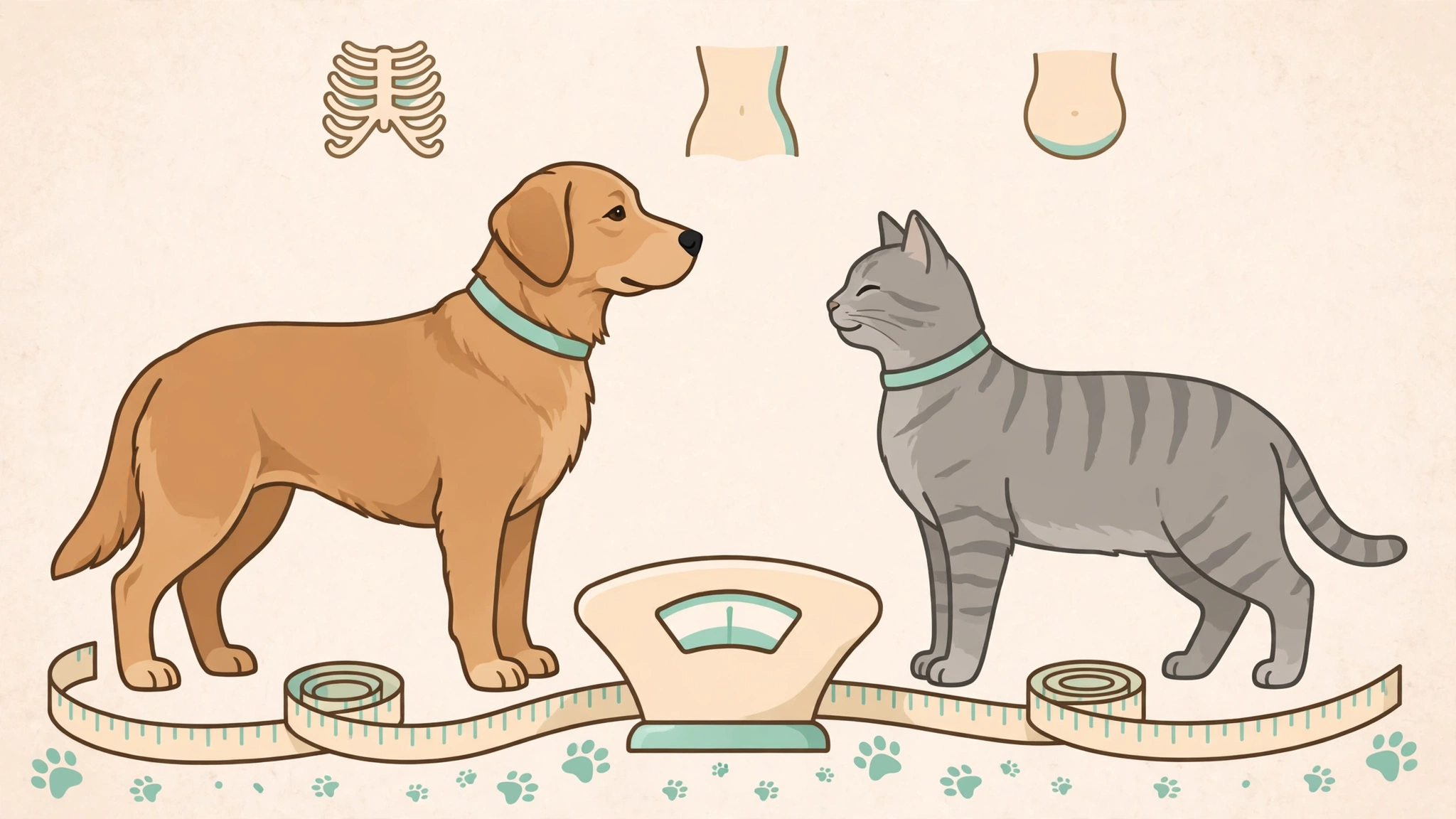
The 9 point BCS scale is the international standard in veterinary medicine (developed from systems by Purina and adopted by WSAVA, the World Small Animal Veterinary Association). Scores 1 to 3 mean underweight, 4 to 5 mean ideal, and 6 to 9 mean overweight to obese. A score of 5 is the textbook ideal, though many vets consider 4 to 5 the healthy range depending on breed, a sighthound at a 4 can be perfectly healthy, while a Labrador at a 6 is carrying too much.
Why does BCS matter more than weight alone? Because healthy weight varies enormously within a breed, and muscle weighs more than fat. A muscular 70 lb dog and a chubby 70 lb dog weigh the same but have very different health outlooks. BCS judges the body you can see and feel, which is what actually predicts health risks.
Pet body condition score chart (1 to 9)
Read each description and find the one that best matches your pet. Be honest, most owners score their pet one point leaner than the vet does.
| Score | Category | What you see and feel |
|---|---|---|
| 1 | Emaciated | Ribs, spine, and hip bones visible from a distance; no fat cover; obvious muscle loss. Vet visit needed. |
| 2 | Very thin | Ribs and spine easily visible; hip bones prominent; minimal fat; visible waist and tucked tummy. |
| 3 | Underweight | Ribs easily felt and slightly visible; tops of hip bones visible; obvious waist from above and tuck from the side. |
| 4 | Ideal (lean) | Ribs easily felt with a thin fat layer; waist clearly visible from above; tummy tuck visible from the side. |
| 5 | Ideal | Ribs felt without pressing hard; waist visible behind the ribs from above; tummy tuck present from the side. |
| 6 | Overweight | Ribs felt only with firm pressure; waist barely visible; tummy tuck faint. Time to adjust food. |
| 7 | Overweight | Ribs hard to feel under fat; no visible waist, back looks broad or flat; slight tummy sag. |
| 8 | Obese | Ribs not felt under heavy fat; no waist; obvious tummy sag; fat deposits on neck, limbs, and lower back. |
| 9 | Severely obese | Massive fat deposits over the whole body; no waist or tuck; belly may drag. Vet supervised plan needed. |
Screening guide only. Breeds vary, sighthounds naturally look leaner, and heavy coated breeds hide their shape. When in doubt, ask your vet.
The three at home checks
You do not need the chart memorized. These three checks, done together, place your pet on the scale in about two minutes.
1. The rib check
Run your hands flat along both sides of the ribcage with light pressure. At an ideal score (4 to 5), you feel each rib easily under a thin covering, like feeling your knuckles through a thin cloth. If you have to press firmly to find them, that points to 6 to 7. If you cannot feel them at all, that points to 8 to 9. If the ribs are visible without touching, that points to 1 to 3.
2. The waist check (view from above)
Stand over your pet and look straight down. Behind the ribs, the body should narrow into a visible waist, an hourglass shape, before widening again at the hips. At 6+, the waist disappears and the back looks straight or barrel shaped from above. At 1 to 3, the waist is exaggerated and the hip bones jut.
3. The tummy check (view from the side)
Look at your pet from the side. The belly should tuck up behind the ribcage, the classic “tucked up” profile. At 6+, that tuck flattens out; at 7 to 8 the belly hangs level with or below the chest; at 9 it sags. In long haired cats, you often have to feel this one rather than see it.
What your score means for feeding
Scored 4 to 5? Keep doing what you are doing, and recheck monthly, weight creeps. Scored 6 to 7? Reduce daily food by about 10%, cut treats to under 10% of daily calories, and add a little more activity. Recheck in a month. Most pets at 6 to 7 return to ideal with nothing more dramatic than measured portions.
Scored 8 to 9? Talk to your vet before cutting food aggressively. Obese pets need a structured weight loss plan, and cats in particular must never be crash dieted, because rapid weight loss can trigger a dangerous liver condition (hepatic lipidosis). Safe loss is roughly 1 to 2% of body weight per week for dogs and even slower for cats.
Scored 1 to 3? Unexplained thinness deserves a vet visit, especially if appetite is normal or increased. That pattern can signal parasites, dental pain, thyroid issues, or malabsorption. Do not simply double the food; find the cause first.
A worked example: scoring Biscuit the Labrador, honestly
Charts become useful the moment you apply one to a real animal, so meet a hypothetical seven year old Labrador, Biscuit, who weighs 84 lb at his annual check. His owner runs the three checks from the section above, in order, and resists the temptation to be kind.
The rib check comes first. Running flat hands along Biscuit’s sides, his owner cannot find individual ribs with light pressure. She has to press firmly, the way you would press to feel something through a thick blanket. That is not the 4 to 5 pattern of ribs felt easily under a thin covering; it points higher. The waist check is next: standing over him, there is no narrowing behind the ribs. His back looks broad and straight, widening slightly toward the hips, the barrel shape the chart ties to a score of 7. Finally the tummy check from the side: no upward tuck behind the ribcage, and the belly hangs roughly level with the chest. Three checks, one answer: Biscuit scores a 7, solidly overweight rather than “big boned”.
What does the plan look like? His vet uses the weight that usually accompanies a 5 for a dog of Biscuit’s frame, about 70 lb in this example, which frames the job honestly: roughly 14 lb to lose, gradually. Rather than slashing food, the vet trims his daily ration by about 10% (a dog eating roughly 800 kcal a day drops to about 720 kcal), counts treats inside that total instead of on top of it, and sets the pace the guide above recommends, around 1 to 2% of body weight per week at most, and in practice toward the gentler end for a dog of his age. At his next monthly check he weighs 82 lb and the ribs are a little easier to find: not a transformation, just the trend doing its quiet work. Owners working through the same exercise for a cat, or checking how life stage changes what “ideal” looks like, can pair the score with the cat age calculator or the dog age calculator a senior pet and a young adult at the same score are not in the same conversation, and age is what tells you which conversation you are having.
Scores compared: what you feel, what it means, what to do first
| Score range | Rib check | Waist and tummy | First move |
|---|---|---|---|
| 1 to 3, Underweight | Ribs felt instantly, often visible | Exaggerated waist; sharp tummy tuck; hip bones prominent | Vet visit before any feeding change, unexplained thinness needs a cause, not just more food |
| 4 to 5, Ideal | Ribs felt easily under a thin fat layer | Waist visible from above; tuck present from the side | Change nothing. Measure the current ration so you can repeat it, and recheck monthly |
| 6, Mildly overweight | Ribs felt only with firm pressure | Waist barely visible; tuck faint | Trim daily food by about 10%, hold treats under 10% of calories, recheck in a month |
| 7, Overweight | Ribs hard to find under fat | No waist from above; tummy level with the chest | A written plan: measured food, counted treats, more daily activity, monthly weigh ins |
| 8 to 9, Obese | Ribs not felt at all | No waist or tuck; belly sags; fat over the neck and lower back | Vet supervised plan from the start, especially for cats, who must never lose weight quickly |
Common mistakes to avoid
- Scoring by eye alone on a coated breed. A thick double coat can hide two full points of condition in either direction. The chart only works with hands on ribs; if you have not touched the dog, you have not scored the dog.
- Comparing your pet with the neighbour’s pet instead of the chart. In streets where most dogs carry extra weight, a 7 starts to look normal and a healthy 5 looks “skinny”. The checks are absolute, ribs, waist, tuck, precisely so the local average cannot move them.
- Cutting a cat’s food hard and fast. Of all the errors on this page, this is the dangerous one. Rapid weight loss in cats can trigger hepatic lipidosis, a serious liver condition. Feline weight loss is a slow, vet guided project, measured in months.
- Leaving treats outside the count. Training treats, dental chews, the corner of a sandwich, the cat treats scattered “just because”, a pet can gain weight entirely on food nobody remembers feeding it. If it is eaten, it is part of the ration.
- Weighing under different conditions each time. Different scales, different times of day, before a walk one month and after dinner the next, the noise swamps the trend. Same scale, same time, same routine, and write it down next to the score.
- Scoring once and filing it away. Condition drifts with seasons, age, neutering, and household routine. A score is a snapshot; the monthly habit of retaking it is the actual health tool.
Biscuit’s story ends the way most successful ones do, undramatically. No crash diet, no guilt, just a number faced honestly, a ration measured instead of guessed, and a score retaken every month. That is all BCS ever asks of an owner: two honest minutes, regularly.
Frequently asked questions
What is a good body condition score for a dog?
A score of 4 to 5 out of 9 is the healthy range for most dogs, ribs easily felt, visible waist from above, tucked tummy from the side. Very lean breeds like Greyhounds and Whippets can be healthy at the lean end of that range.
What is a good body condition score for a cat?
The same 4 to 5 out of 9 applies to cats: ribs felt with light pressure, a slight waist behind the ribs, and a modest tummy tuck. Long haired cats need the hands on rib check, since fur hides the visual cues.
My vet said my pet is a 6. Is that bad?
A 6 is mildly overweight, not an emergency, but a genuine signal. Pets at 6+ face higher risks of joint problems, diabetes (especially cats), and shorter lifespans in studies. The fix is usually simple: measure food, trim 10%, and recheck in a month.
Can I score my pet if it has very thick fur?
Yes, rely on the rib check with your hands rather than your eyes. Part the fur and feel the ribcage, waist, and belly directly. Thick coats fool the eye completely, which is why vets always score by touch.
How often should I check my pet’s body condition score?
Monthly is ideal, it takes two minutes and catches drift early. Weighing monthly on the same scale pairs well with it: the scale catches the trend, and BCS tells you whether the trend matters.