

How many calories should your cat eat per day? This cat calorie chart by weight gives you a realistic 2026 starting point, built on the resting energy requirement (RER) formula used in veterinary nutrition: RER = 70 × (weight in kg)0.75. Find your cat’s weight below and match the row to your cat’s lifestyle. You can also check your cat’s life stage with our cat age calculator.
General information only, your vet knows your pet best. These are estimates, not prescriptions.
How cat calorie needs are calculated
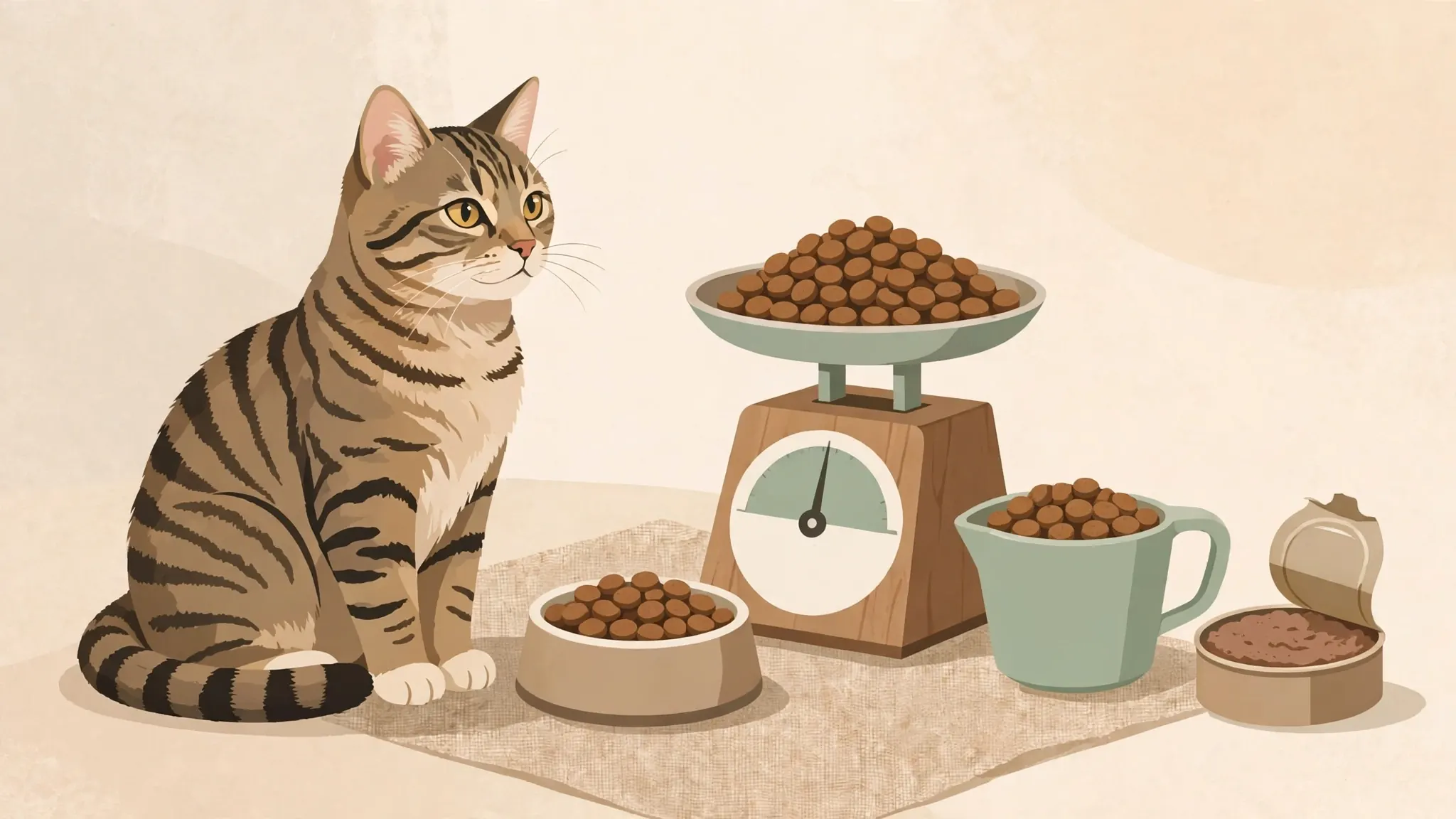
Veterinary nutritionists start with the resting energy requirement, the calories a cat burns simply existing in a comfortable environment. It scales with body weight to the power of 0.75, so calorie needs rise more slowly than weight. Doubling a cat’s weight does not double its calorie needs.
Most pet cats fall into one profile: the indoor neutered adult, needing about 1.2 × RER per day. That multiplier is lower than a dog’s because the average house cat is, frankly, not very active, studies show indoor cats may rest 16 to 20 hours a day. An active or intact cat that plays hard or roams needs closer to 1.4 × RER. Kittens, pregnant queens, and nursing mothers need more; seniors and overweight cats need less.
Cat calorie chart by weight (2026)
The chart below covers common adult cat weights. Use the “indoor neutered” column for the typical spayed or neutered house cat, and the higher column for intact or genuinely active cats.
| Weight | Weight (kg) | RER (kcal/day) | Indoor neutered | Active / intact |
|---|---|---|---|---|
| 6 lb | 2.7 | 148 | 175 to 180 | 205 to 210 |
| 8 lb | 3.6 | 184 | 220 to 225 | 255 to 260 |
| 10 lb | 4.5 | 218 | 260 to 265 | 300 to 310 |
| 12 lb | 5.4 | 249 | 295 to 300 | 345 to 350 |
| 15 lb | 6.8 | 295 | 350 to 355 | 410 to 415 |
| 20 lb | 9.1 | 366 | 435 to 440 | 510 to 515 |
Estimates for adult cats. Kittens, pregnant or nursing queens, senior, or overweight cats need different targets, ask your vet.
What changes your cat’s calorie needs
Spaying and neutering typically cut calorie needs by around 20 to 30%, and the timing is cruel: appetite often stays the same while metabolism drops, which is why indoor neutered cats are the classic candidates for slow, steady weight gain. The indoor lifestyle compounds it. An outdoor or highly playful cat can burn meaningfully more than a cat whose day is windowsill, food bowl, windowsill.
Kittens are the big exception. A growing kitten needs roughly 2 to 2.5 times the calories per pound of an adult, fed as kitten formulated food until about 12 months (longer for large breeds like Maine Coons). Senior cats, roughly 11 and up, often need fewer calories, but watch for the opposite problem: unexplained weight loss in a senior cat deserves a vet visit, as it can signal thyroid, kidney, or dental issues.
Wet versus dry food matters more than most owners realize. A typical dry food packs 350 to 450 kcal per cup, while wet food runs roughly 25 to 35 kcal per ounce, so a cat eating a full cup of dry food plus a can of wet food can easily land at double its daily target. Always read the kcal figure on the label and do the arithmetic.
How to use this chart
Choose the row for your cat’s ideal weight, not its current weight. For an overweight cat heading toward a 10 lb target, feed the 10 lb row. That is the whole point. Weigh food with a kitchen scale instead of eyeballing portions; a “handful” of kibble is one of the least reliable measurements in existence.
Split the daily total into two or three small meals. Cats are natural grazers, and smaller meals suit their digestion better than one large bowl, though free feeding dry food all day is a fast track to overeating for most indoor cats. Reassess every few weeks: you should feel the ribs with light pressure, see a slight waist from above, and notice a modest tummy tuck from the side.
Adjust in 10% steps. If weight creeps up over a month, cut the daily amount by 10%. If your cat is losing condition or seems constantly hungry at mealtimes, add 10% back. Gradual beats dramatic, and any sudden appetite or weight change is worth a vet check.
Worked example: an 11 lb indoor cat, bowl by bowl
The chart above jumps in steps, so here is a complete calculation for a weight that falls between its rows. Meet a typical patient: an indoor, neutered cat whose ideal weight is 11 lb. Eleven pounds is 11 × 0.4536 ≈ 4.99 kg, call it 5.0 kg. Now run the formula the guide opened with: RER = 70 × (5.0)0.75. Five to the power of 0.75 is about 3.34, so RER ≈ 70 × 3.34 ≈ 234 kcal per day just for resting. As an indoor neutered adult, this cat sits in the 1.2 multiplier group, giving a daily target of 234 × 1.2 ≈ 280 kcal. If the same cat were intact and genuinely active, the 1.4 multiplier would give 234 × 1.4 ≈ 327 kcal, nearly 50 kcal a day more, which is exactly why matching the column to the cat in front of you matters. To place this cat in its wider life picture, the cat age calculator translates its age into human equivalent years, which helps explain why a senior’s target drifts down over time.
Now turn 280 kcal into food, because no cat eats kilocalories in the abstract. Suppose the dry food in the cupboard is labelled 380 kcal per cup, right in the typical range the guide describes. The daily ration is 280 ÷ 380 ≈ 0.74 of a cup, which in kitchen terms is three quarters of a cup, weighed on a scale rather than scooped by eye. Split across two meals, that is about 140 kcal per meal. Swap the dry food for wet food at roughly 30 kcal per ounce and the same target becomes 280 ÷ 30 ≈ 9.3 ounces across the day. And treats come out of the same budget: keeping treats near 10% of the day means about 28 kcal of treats, a small handful, not a second dinner. Every number in this paragraph came from the label of one specific food, which is the habit that makes the chart work in a real kitchen.
One more turn of the same example shows the weight loss use. If this cat currently weighs 13 lb but its ideal weight is 11 lb, you do not feed the 13 lb row. You feed the 11 lb target you just calculated, 280 kcal a day, and let the modest deficit work slowly. Cats in particular should slim gradually and under a vet’s eye, because rapid restriction carries risks for them that it does not for dogs. Weigh monthly, adjust by about 10% if nothing changes over a month, and treat the chart as the starting estimate it is. The same patience applies at the other end of life: queens that are pregnant or nursing need substantially more than any adult row here, and a cat pregnancy calculator helps you track where in the pregnancy she is while your vet sets her feeding plan.
Calorie targets by life stage compared
Weight sets the base number, but life stage decides the adjustment. This table compares the profiles owners most often confuse, using the guide’s own multipliers and rules.
| Profile | How the target is set | For the 11 lb example |
|---|---|---|
| Indoor neutered adult | 1.2 × RER, the default house cat profile | About 280 kcal/day |
| Active or intact adult | 1.4 × RER, roaming, playing, unneutered | About 327 kcal/day |
| Kitten (under about 12 months) | Growth food, roughly 2 to 2.5× an adult’s calories per pound | Do not use the adult rows, follow kitten guidance |
| Senior (roughly 11+) | Adult target as the starting point, monitored closely | About 280 kcal/day, adjusted on body condition |
| Overweight adult | Feed the ideal weight row, not the current weight row | 280 kcal/day (the 11 lb target), vet guided |
Two rows deserve emphasis. The kitten row is not a bigger adult portion, kittens need kitten formulated food and far more energy per pound because they are building a body, not maintaining one. And the senior row is a monitoring instruction as much as a number: an older cat quietly losing weight on the “correct” calories is showing you a symptom, not a feeding success.
Common mistakes to avoid
- Feeding for the weight the cat is, not the weight it should be. An overweight cat fed its current weight row maintains the overweight. The chart works by ideal weight. That single choice is most of the method.
- Free feeding dry food all day. Kibble at 350 to 450 kcal per cup is energy dense, and an open bowl removes every portion cue. Measured meals are what make a daily target real.
- Forgetting that treats are food. Treats, table scraps, and the second cat’s leftovers all spend from the same 280 kcal. Owners who “barely feed anything” are often feeding plenty, just not at mealtimes.
- Guessing portions by volume. A “cup” of one kibble can differ sharply from another, and a heaped scoop is not a cup. A cheap kitchen scale ends the argument in one weighing.
- Cutting a cat’s food sharply to force quick loss. Gradual, vet guided reduction is the safe route for cats. A cat that stops eating properly needs a vet promptly, not a smaller bowl and more patience.
- Never rechecking the label after switching foods. Two foods that look identical can differ by a hundred kilocalories per cup. Every brand change restarts the arithmetic in the worked example above.
Reading the label: turning kilocalories per kilogram into grams
Many foods print their energy as kilocalories per kilogram rather than per cup, which defeats owners who think in scoops. The conversion is one division. Suppose a food is labelled 3,800 kcal per kilogram. That is 380 kcal per 100 grams. For the 11 lb cat from the worked example, with a 280 kcal daily target, the day’s food weighs 280 ÷ 380 × 100 ≈ 74 grams. Weigh out 74 grams once, note what it looks like in your usual scoop or bowl, and you have a visual reference that survives the week, while still reweighing whenever the food changes, because a new label restarts this arithmetic just as it restarts the cup arithmetic.
Frequently asked questions
How many calories does a 10 lb cat need per day?
A 10 lb (4.5 kg) adult cat has a resting energy requirement of about 218 kcal. A typical indoor neutered cat needs roughly 260 to 265 kcal per day, while an active or intact cat needs about 300 to 310 kcal. Treats count toward that total.
Why did my cat gain weight after being spayed or neutered?
Neutering typically lowers calorie needs by about 20 to 30% while appetite often stays the same. If portions were not reduced after the procedure, the surplus turns into weight gain over months. Switch to the “indoor neutered” column above and reassess.
Can I use this chart for my kitten?
Not directly. Kittens need roughly 2 to 2.5 times the calories per pound of adults because they are growing rapidly. Feed a kitten formulated food and follow the label’s feeding guide for the kitten’s age, with your vet’s guidance on portions.
Is wet food or dry food better for weight control?
Wet food is often easier for weight control because it is less calorie dense, roughly 25 to 35 kcal per ounce versus 350 to 450 kcal per cup of dry food, and its water content helps cats feel full. Either can work if you measure portions against your cat’s daily target.
My senior cat is losing weight. Should I feed more?
Unintentional weight loss in a senior cat (roughly 11+) is a vet visit, not just a feeding adjustment. It can signal thyroid, kidney, or dental problems. Get the underlying cause checked before changing the diet on your own.