

British recipes speak a different language: aubergines, courgettes, mince and puddings that are not pudding. This guide translates the most confusing UK cooking terms into their US equivalents (and vice versa), so you can follow any recipe from either side of the Atlantic. When a recipe also mixes cups, grams and ounces, convert units free with our instant converter.
UK to US cooking terms: the full table
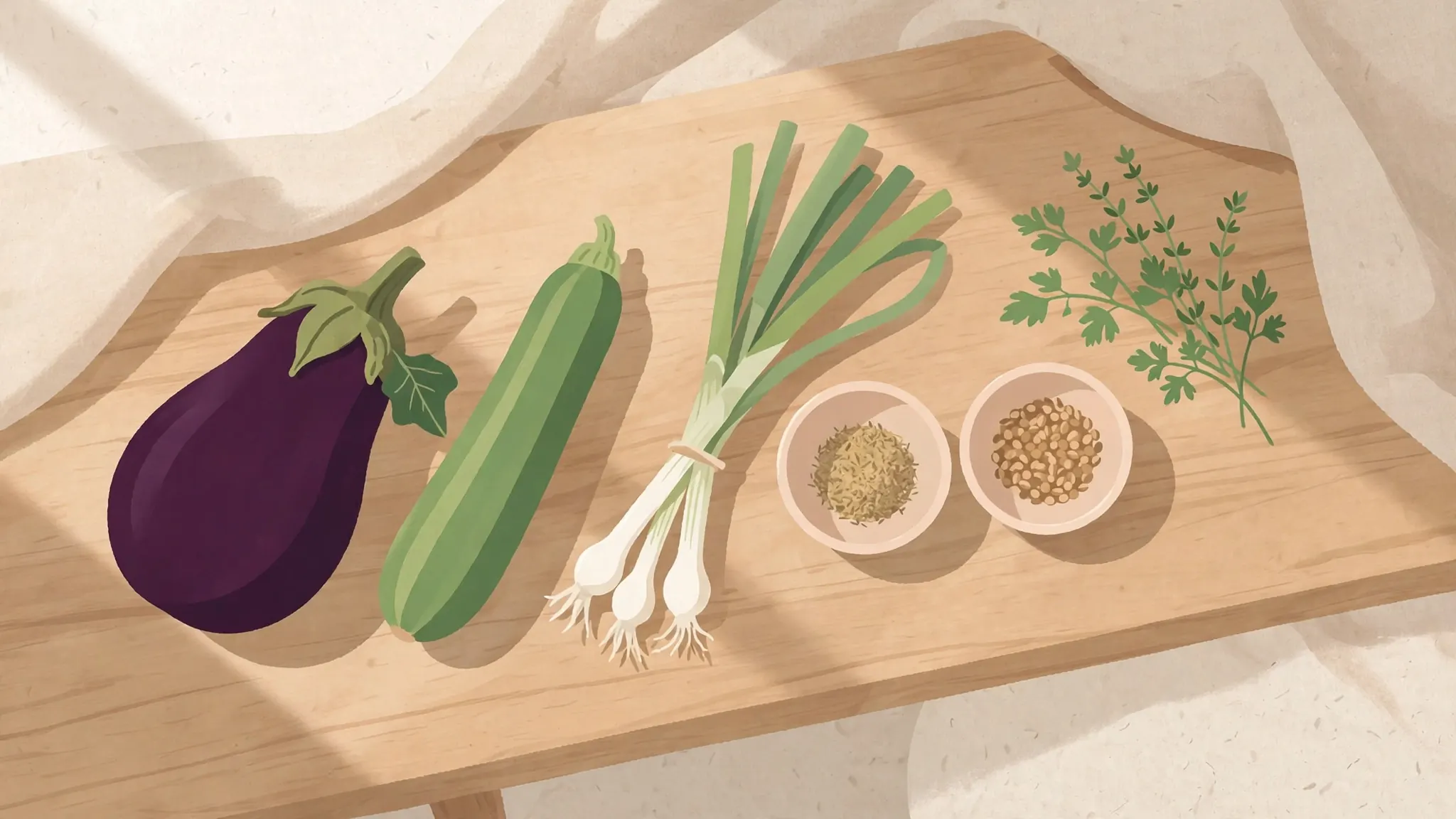
The terms below are the ones that actually cause mistakes in the kitchen, ingredients with different names, and a few false friends where the same word means something different. Check the notes column for the traps.
| UK term | US term | Notes |
|---|---|---|
| Aubergine | Eggplant | Same vegetable, different name |
| Courgette | Zucchini | A large courgette is called a marrow in the UK |
| Coriander (leaves) | Cilantro | UK “coriander” usually means the fresh leaves; the seeds are “coriander seeds” in both |
| Rocket | Arugula | Peppery salad leaf |
| Mange tout | Snow peas | Sugar snaps are a different, plumper pea |
| Spring onion | Scallion / green onion | Identical ingredient |
| Swede | Rutabaga | Called “neeps” in Scotland |
| Mince / minced beef | Ground beef | “Mince pies” are unrelated, they are sweet Christmas pastries |
| Rashers (bacon) | Strips of bacon | UK bacon is usually back bacon; US bacon is streaky |
| Chips | French fries | UK chips are thicker cut than US fries |
| Crisps | Chips / potato chips | The classic false friend: do not confuse with UK “chips” |
| Pudding | Dessert | In the UK, “pudding” can mean any dessert course, not just the custard like dish |
| Biscuit | Cookie | A US “biscuit” is a savoury scone like bread, completely different |
| Scone | Biscuit (approximate) | Closest US match, though scones are usually sweeter |
| Flapjack | Granola bar (approximate) | UK flapjacks are baked oat bars; a US flapjack is a pancake |
| Treacle | Molasses (approximate) | Golden syrup is lighter; black treacle is closest to molasses |
| Caster sugar | Superfine sugar | Finer than granulated, coarser than powdered |
| Icing sugar | Powdered / confectioners’ sugar | Identical ingredient |
| Plain flour | All purpose flour | Identical ingredient |
| Strong flour | Bread flour | Higher protein for yeast baking |
| Cornflour | Cornstarch | Warning: US “corn flour” is different, it is finely ground cornmeal |
| Double cream | Heavy cream | Double cream is slightly richer (48% fat vs ~36%) |
| Single cream | Light cream / half and half (approximate) | Will not whip |
| Clotted cream | No direct US equivalent | Thick, spoonable cream served with scones |
| Crème fraîche | Sour cream (approximate) | Milder and less tangy than US sour cream |
| Greek yoghurt | Greek yogurt | Same thing, different spelling |
| Grill (verb) | Broil | “Grill the chicken” in a UK recipe means cook under overhead heat |
| Hob | Stovetop / cooktop | The flat cooking surface, gas or electric |
False friends that ruin recipes
Four pairs deserve special caution. “Chips” and “crisps” are swapped between the countries, serving crisps when a UK recipe says chips gives you a bag of potato chips next to your fish. A UK “biscuit” is a cookie, while a US “biscuit” is a bread closer to a scone. UK “cornflour” is cornstarch, but US “corn flour” is ground cornmeal, using one for the other will wreck a sauce. And UK “pudding” usually just means dessert, so “what’s for pudding?” is not asking about a specific dish. When in doubt, convert units free and double check the ingredient list, not just the name.
Worked example: cooking a British recipe in an American kitchen
Take a typical UK weeknight recipe: a cottage pie that calls for 500 g of minced beef, one aubergine diced into the sauce, a tablespoon of cornflour to thicken it, 150 ml of double cream stirred in at the end, and a pudding of scones afterwards. Translating it for a US kitchen changes almost every line. The minced beef is ground beef. The aubergine is an eggplant. The cornflour is cornstarch, not US corn flour, which is ground cornmeal and would make the sauce gritty instead of glossy. The double cream becomes heavy cream. And the pudding is simply dessert; the scones that follow are sweet, biscuit like bakes served with jam and cream, not savoury US biscuits. If your recipe also gives quantities in grams and millilitres, run them through the unit converter rather than guessing cup equivalents at the stove.
Now check the quantities, because translation is only half the job. The recipe is written for four people and your household is six, so everything scales by one and a half: 500 g of mince becomes 750 g, and 150 ml of cream becomes 225 ml. A recipe scaler calculator does that arithmetic in one pass and keeps the ratios exact, which matters more for the cornflour than for the vegetables, too little thickener and the sauce stays soupy, too much and it turns gluey. The liquid measures hide the sneakiest trap of all: if the original recipe had called for a pint of stock, a British pint is 568 ml while an American pint is 473 ml, a difference of 95 ml. Follow the US measure in a UK recipe and the pie filling comes out noticeably drier; follow the UK measure in a US recipe and it can flood the dish.
Temperature is the third translation. A UK recipe that says “bake at 190°C, gas mark 5” wants a moderately hot oven. Converted, 190°C is 374°F, most American cooks would set 375°F and carry on. The method words matter as much as the numbers: if the recipe finishes by saying “grill for 3 minutes until golden”, that is an instruction to use overhead heat, the US broiler, not to take the dish outside to a barbecue. Likewise, a sauce made “on the hob” is made on the stovetop, and anything described as “fried off” in a pan simply means browned in fat before liquid is added. Reading the whole recipe once with these swaps in mind, before you touch an ingredient, prevents nearly every transatlantic kitchen mishap.
Same word, different meaning: the traps side by side
The most dangerous terms are not the unfamiliar ones like aubergine, those send you to a dictionary. The dangerous ones are words you think you already know:
| Word | In the UK it means | In the US it means | What goes wrong if you mix them up |
|---|---|---|---|
| Chips | Thick cut fried potatoes | Thin crisps in a bag | You serve a bag snack beside the fish instead of fries |
| Cornflour / corn flour | Cornflour is the fine white thickener (cornstarch) | Corn flour is finely ground cornmeal | Sauces turn gritty and fail to thicken properly |
| Biscuit | A sweet baked snap or cookie | A soft savoury bread roll | Dessert and side dish swap places entirely |
| Pudding | Any dessert, or the dessert course itself | A specific soft custard like dish | You hunt for a custard recipe when the cook just means dessert |
| Flapjack | A baked oat bar held together with syrup | A pancake | Breakfast and bake sale items get confused |
| Grill | Cook under overhead heat (broil) | Cook over an outdoor barbecue | Cheese toppings never brown and timings go wrong |
Common mistakes to avoid
- Assuming a familiar word is a safe word. Chips, biscuits and pudding cause more failed recipes than any exotic ingredient. Translate the whole list, not just the words that look foreign.
- Swapping cornflour for corn flour. UK cornflour is US cornstarch. American corn flour is a different product entirely and will not thicken a sauce the same way.
- Using US cup measures for a UK pint. The two pints differ by 95 ml. When a recipe is written in pints, check which country published it before you measure any liquid.
- Putting a UK “grill” recipe on a barbecue. Grill means broil, overhead heat inside the oven. Cheese topped and gratined dishes depend on it.
- Expecting mince pies to contain meat. Despite the name, modern mince pies are sweet Christmas pastries filled with spiced fruit. Ordering ingredients for a savoury pie is a December classic.
- Translating the ingredients but not the method. Hob, grill and gas mark all hide in the instructions rather than the ingredient list. Read the method through once in translation before you start cooking.
A final reassurance: most swaps are one to one and forgiving. Eggplant behaves exactly like aubergine because it is one, ground beef cooks exactly like mince, and heavy cream stands in for double cream in everything except the richest set desserts, where its slightly lower fat can make a mousse a touch softer. The recipes that fail are the ones where a single false friend, usually cornflour, chips or the pint, quietly changes the dish. Translate those few words with care, convert the measures with the unit converter, and a recipe written on either side of the Atlantic will come out the way its author intended.
Translating in the other direction: an American recipe in a British kitchen
The same swaps run in reverse when a British cook follows an American recipe. Ground beef from a US chilli recipe is mince at a UK butcher, and the recipe’s request for cilantro means fresh coriander leaves, not the seeds. The traps reverse too: a US recipe calling for a skillet of “chips” as a side dish is not asking for oven chips at all, and any American instruction to bake biscuits means soft savoury rolls that a UK cook would approximate with a plain scone dough, serving British biscuits with gravy would baffle everyone at the table. Liquid measures flip as well: an American cup is a volume measure of about 237 ml, while UK recipes written in millilitres and grams expect a scale, so converting a US recipe properly means weighing the flour rather than scooping it and hoping. The working rule in both directions is identical: translate the ingredient names first, convert the measures second, and only then start cooking.
Frequently asked questions
What is caster sugar in the US?
Caster sugar is sold as superfine sugar in the US. It dissolves faster than granulated sugar, which is why UK baking recipes specify it for cakes, meringues and custards.
What do Americans call courgettes?
Zucchini. A courgette and a zucchini are the same vegetable; only the name changes. Aubergine is likewise eggplant, and rocket is arugula.
Is UK mince the same as US ground beef?
Yes. “Mince” or “minced beef” in a UK recipe means ground beef in the US. Do not confuse it with mincemeat, the sweet spiced filling used in Christmas mince pies.
What is the difference between UK chips and US chips?
UK “chips” are thick cut fried potatoes, what Americans call French fries. What Americans call “chips” are “crisps” in the UK. This is the most common transatlantic recipe mix up.
What does “grill” mean in a UK recipe?
It means to cook under direct overhead heat, the US equivalent is “broil”. A UK recipe that says “grill for 5 minutes” wants the food under the oven’s top element, not on a barbecue.
What is double cream in American recipes?
The closest US match is heavy cream. Double cream is slightly richer (about 48% fat versus heavy cream’s 36%), but heavy cream substitutes successfully in almost every recipe.
What does “mince” mean in a UK Christmas recipe?
Nothing to do with meat. “Mincemeat” is a sweet mixture of dried fruit, suet, sugar and spices used in mince pies, a traditional Christmas pastry. If a December recipe mentions mince pies, reach for the fruit filling, not the butcher.