

The difference between a jammy soft boiled egg and a chalky hard boiled one is a matter of minutes. This egg boiling time chart gives you exact timings for large eggs lowered into already boiling water, from runny 6 minute eggs to fully set 12 minute eggs. Need to scale timings or switch units for a recipe? Convert units free with our instant converter.
Egg boiling times (large eggs, from boiling)
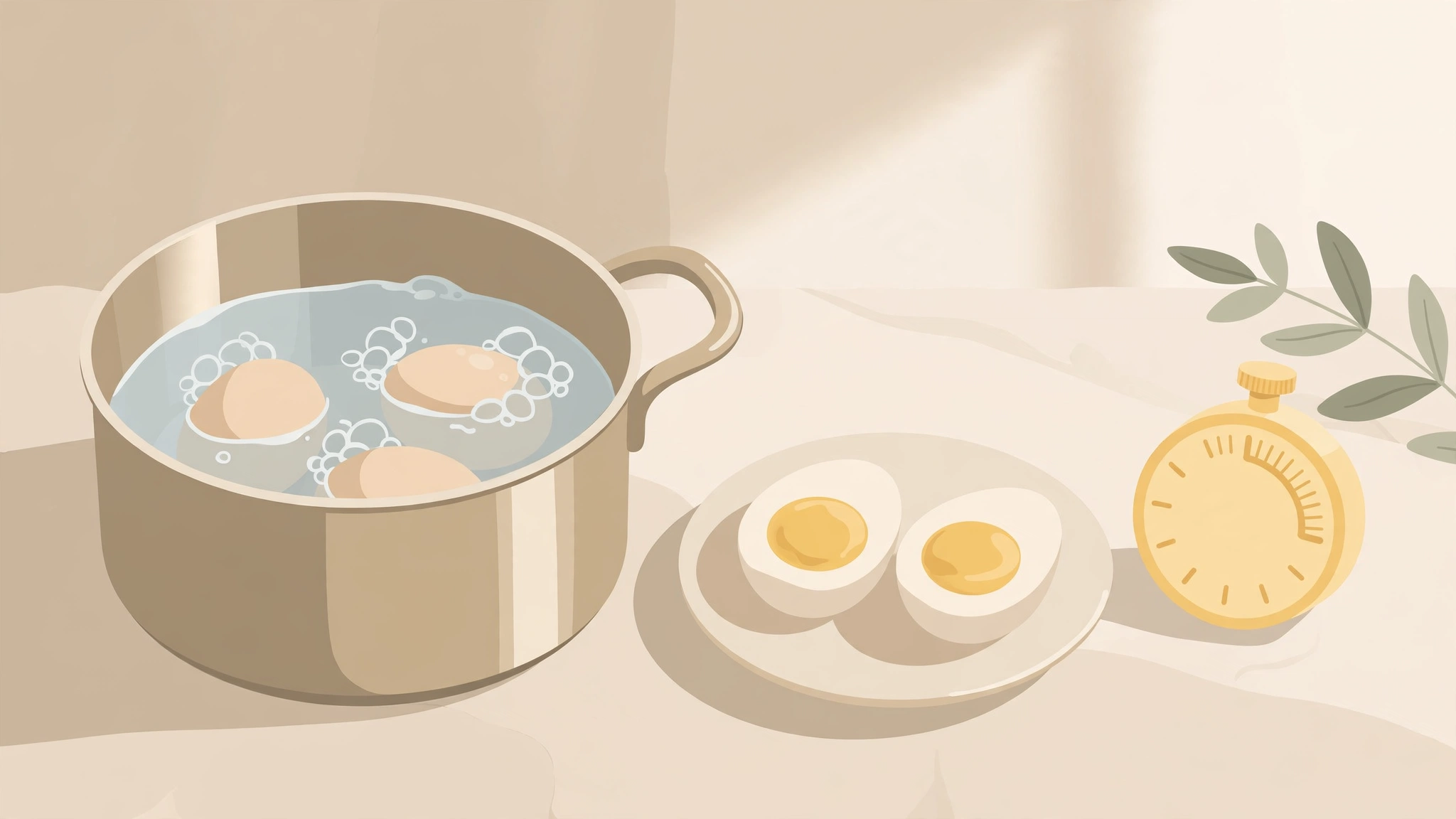
These times assume large eggs taken straight from the fridge and lowered gently into a rolling boil. Start your timer the moment the last egg goes in, and keep the water at a steady gentle boil throughout.
| Style | Time | White | Yolk | Best for |
|---|---|---|---|---|
| Soft boiled | 6 minutes | Just set | Runny, liquid gold | Soldiers, ramen, toast dipping |
| Medium soft | 7 minutes | Fully set | Jammy at the edges, runny centre | Grain bowls, salads |
| Medium | 8 minutes | Firm | Jammy, custardy | Scotch eggs, noodle bowls |
| Medium hard | 10 minutes | Firm | Mostly set, slightly soft centre | Slicing onto salads |
| Hard boiled | 12 minutes | Firm | Fully set, pale yellow | Egg sandwiches, devilled eggs, meal prep |
Adjusting for egg size and altitude
Egg size shifts the timing: medium eggs need roughly 30 to 60 seconds less than large eggs, while extra large eggs need about a minute more. At high altitude, water boils below 100°C, so cooking slows down, add roughly a minute per 300 metres of elevation as a starting point and test one egg first. Older eggs (a week or more past purchase) also peel far more easily than very fresh ones, because the shell membrane loosens over time.
The ice bath trick for perfect peeling
As soon as the timer ends, transfer the eggs into a bowl of iced water for at least 5 minutes. This stops carry over cooking immediately, which is the main cause of the grey green ring around the yolk, and it makes the shells slip off cleanly. Crack the shell all over on the counter, then roll the egg gently under your palm before peeling under a thin stream of cold water.
How long do boiled eggs keep?
Hard boiled eggs (10 to 12 minutes) keep for up to a week in the refrigerator, stored in their shells. Soft boiled eggs with runny yolks are best eaten immediately and should not be stored, since the undercooked yolk is more perishable. Always refrigerate boiled eggs within two hours of cooking, and keep them in the main body of the fridge rather than the door, where the temperature fluctuates most.
To tell a boiled egg from a raw one, spin it on the counter: a hard boiled egg spins smoothly and quickly, while a raw egg wobbles because the liquid inside sloshes around. This saves you from cracking the wrong egg into your cake batter.
Boiling eggs in big batches
Cooking for a crowd? Use a wide pot so the eggs sit in a single layer, stacking them leads to uneven cooking and cracked shells. The timings in the chart stay the same, but bring the water fully back to a rolling boil before starting the timer, since a large batch of cold eggs drops the water temperature noticeably. Work in batches if your pot is small, and convert units free if a bulk recipe lists its ingredients in weights rather than counts.
Worked example: three doneness levels from one pot
Saturday breakfast for three people who all like their eggs differently: one hard boiled, one medium, one soft with a runny yolk. You do not need three pots. You need one pot and a staggered start, because all the eggs should come out at the same moment. Using the chart times (hard 12 minutes, medium 8, soft 6), work backwards from a shared finish:
- Minute 0: water at a rolling boil; lower in the hard boiled eggs and start the timer.
- Minute 4: lower in the medium eggs, they need 8 minutes, and 12 − 8 = 4, so they join the pot four minutes late.
- Minute 6: lower in the soft boiled eggs, 12 − 6 = 6 minutes after the first batch.
- Minute 12: every egg comes out together, straight into the ice bath. The hard eggs are fully set, the medium ones jammy, the soft ones runny, each exactly as ordered.
Two details make this work. First, lower each batch in gently with a spoon so the shells do not crack against the pot, and let the water return to a gentle boil before you rely on the timer again, a cold egg drops the temperature briefly. Second, if the eggs are different sizes, put each person’s egg in by size as well as by style: a medium egg aiming for “medium” needs a minute or so less than a large one, so it goes in a minute later than the schedule above. If you are scaling the whole breakfast up for guests, a recipe scaler calculator helps with the rest of the menu while the eggs look after themselves.
Adjusted times by egg size
The main chart is written for large eggs. Use this version when your eggs are smaller or larger, medium eggs need roughly 30 to 60 seconds less, extra large about a minute more:
| Style | Medium eggs | Large eggs | Extra large eggs |
|---|---|---|---|
| Soft boiled | 5 to 6 minutes | 6 minutes | 7 minutes |
| Medium soft | 6 to 7 minutes | 7 minutes | 8 minutes |
| Medium | 7 to 8 minutes | 8 minutes | 9 minutes |
| Medium hard | 9 to 10 minutes | 10 minutes | 11 minutes |
| Hard boiled | 11 minutes | 12 minutes | 13 minutes |
Treat these as starting points rather than guarantees: shell thickness, exact egg weight, and how crowded the pot is all nudge the result. Boil one test egg when you open a new box, note the time that worked, and write it on the box, your future self will thank you. And if a recipe you are following lists water or other ingredients by weight, convert the units before you start so everything stays consistent.
Common mistakes to avoid
- Starting the timer too early. The chart times begin when the eggs go into already boiling water. Timing from a cold start, or while the water is still recovering its boil after a big batch goes in, undercooks everything.
- Skipping the ice bath. Eggs keep cooking in their shells after they leave the pot. Without iced water to stop the process, a perfect 8 minute egg drifts toward 10 minute territory and the yolk edges turn grey green.
- Using the freshest eggs for hard boiled. Very fresh eggs cling to their shells and peel in frustrating chunks. For hard boiled eggs you plan to peel, use eggs that have been in the fridge for a week or so.
- Overcrowding the pot. Stacked eggs cook unevenly and knock against each other, cracking shells and leaking whites. One layer, with room to move, every time.
- Boiling violently the whole way. A hard rolling boil rattles eggs against the pot and cracks them. Bring the water to a boil, add the eggs, then ease it back to a steady, gentle boil.
- Forgetting your altitude. If you live well above sea level, water boils cooler and eggs cook slower. Add time as the altitude section above suggests, and test one egg before committing the whole batch.
Boiling is not the only way: steaming and the cold start
The chart in this guide is based on eggs lowered into boiling water because that method gives the most repeatable timing. Two other methods are worth knowing, and honest about their trade offs. Steaming eggs in a basket over boiling water, lid on, cooks at the same temperature as boiling, so most cooks use the same times from the chart as a starting point and adjust by test egg. Its real advantage is gentleness: eggs do not knock against each other, so cracked shells are rarer, and a small amount of water heats faster than a full pot.
The cold start eggs covered with cold water, brought to a boil together, then timed or rested off the heat, is the method many people learned first, and it works, but its timing depends on your pot, your hob and how much water you used, because the eggs are cooking during the whole warm up. Two kitchens following the same cold start recipe can land a full stage apart. If it is the method you know and love, keep it, just standardise your own pot and water level, time one test egg, and write your number down. What you should not do is mix methods mid recipe: the chart times in this guide assume a boiling start, and applying them to a cold start pot is the most common reason “the chart did not work.” Pick one method, calibrate it once with a test egg, and it will serve you for years.
Storing and reheating boiled eggs
A few storage details are worth adding to the keeping times above. Peel only what you are about to eat: the shell is a genuinely good wrapper, protecting the white from drying out and from absorbing fridge odours, so eggs stored in their shells keep their texture far better than peeled ones. If you do peel ahead, for a packed lunch, say, keep the eggs in a sealed container and eat them within a day or two, and expect the whites to be a little firmer and drier than a freshly peeled egg.
To serve a hard boiled egg warm after storage, warm it gently in a bowl of hot (not boiling) water for a few minutes rather than reaching for the microwave. A whole boiled egg microwaved in its shell, or even peeled, can build up steam inside the yolk and burst, sometimes as it is bitten into. The warm water bath takes slightly longer and heats the egg through without the drama, ready for soldiers, salads, or a very late breakfast.
Frequently asked questions
How long do you boil eggs for soft boiled?
6 minutes in already boiling water for a large egg. The white will be just set and the yolk fully runny. Move the egg straight into iced water afterwards to stop the cooking.
How long for a perfect hard boiled egg?
10 to 12 minutes. At 10 minutes the yolk is mostly set with a slightly soft centre; at 12 minutes it is fully firm and pale yellow. Do not go past 12 minutes or the yolk turns chalky and develops a grey green ring.
Should you start eggs in cold or boiling water?
Lowering eggs into already boiling water gives the most consistent, repeatable timing, which is what this chart is based on. Starting in cold water works too, but the timing becomes harder to standardise because it depends on how fast your hob brings the water to a boil.
Why is there a green ring around my egg yolk?
The green grey ring is iron sulphide, formed when eggs are overcooked or cool down too slowly. It is harmless, but you can avoid it by keeping to the times in the chart and shocking the eggs in iced water immediately.
How do you make boiled eggs easier to peel?
Use eggs that are at least a week old, boil rather than steam cold start them, and plunge them into iced water for 5 minutes. Crack the shell all over and peel under cold running water for the cleanest result.
Do smaller eggs need less boiling time?
Yes. Medium eggs need about 30 to 60 seconds less than the times in this chart, and extra large eggs need about a minute more. If you cook mixed sizes together, the smaller ones will be one stage softer than the larger ones.