

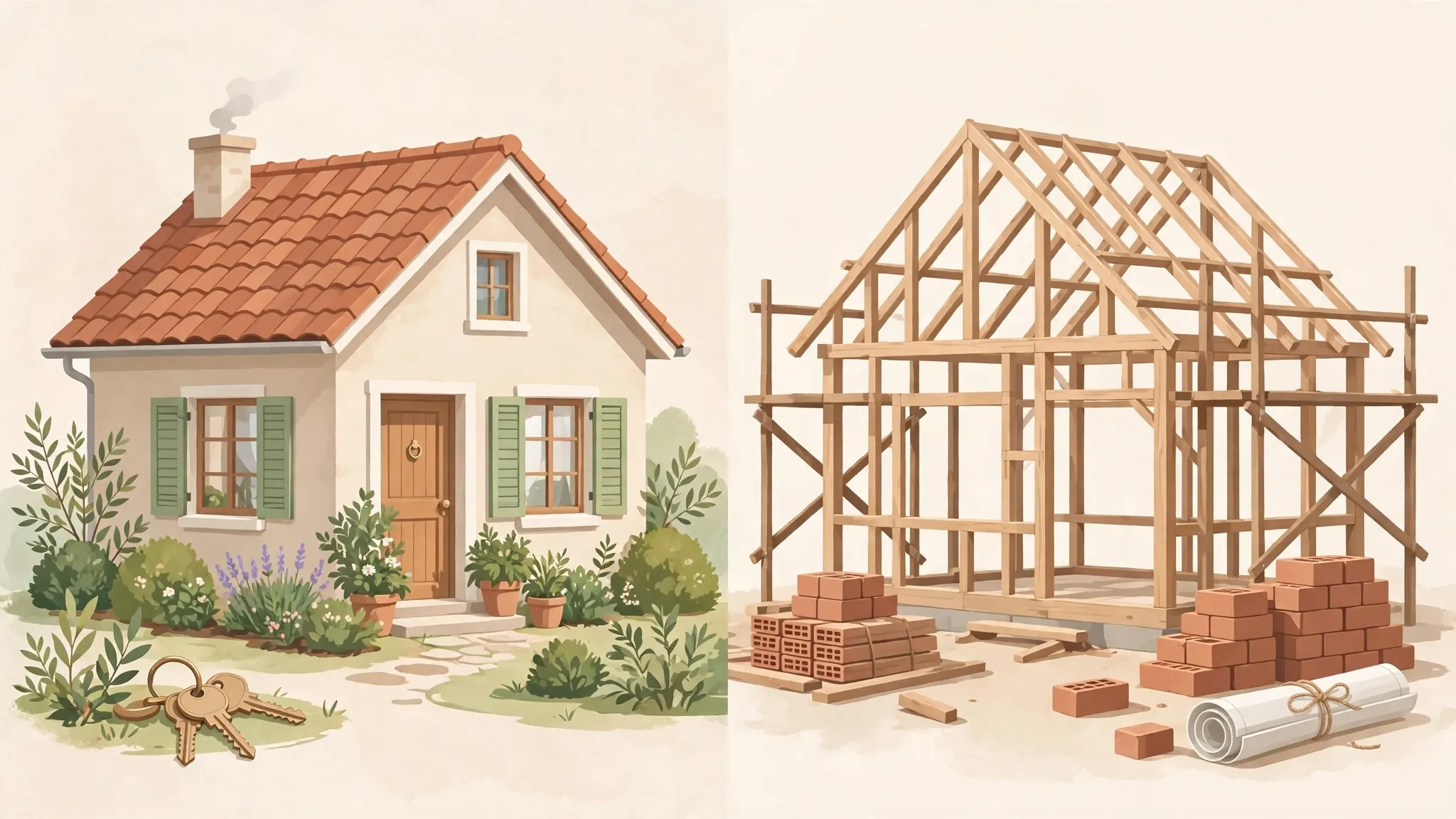
Should you buy an existing home or build new from scratch? The honest answer is that building usually costs more and takes far longer but it buys you exactly the home you want, with new systems and a builder warranty. Buying existing is faster and often cheaper per square foot, but you inherit someone else’s floor plan and wear and tear. Before committing to either path, run your budget through a house affordability calculator construction financing has extra costs and stricter requirements that change the math. Here is the full, no fluff comparison.
Build vs buy: the cost comparison
| Cost factor | Buying existing | Building new |
|---|---|---|
| Typical total cost | Market price; often lower per square foot | Land + construction + fees; typically 10 to 30% more than comparable existing homes |
| Land cost | Included in the price | Separate purchase, varies enormously by location; can rival the build cost in prime areas |
| Financing | Standard mortgage; close in 30 to 60 days | Construction loan (higher rate, interest only during build), then refinance or convert to permanent mortgage, two closings, two sets of fees |
| Surprise costs | Inspection surprises: roof, foundation, systems (budget 1% of value/year for maintenance) | Cost overruns: change orders, material price swings, site surprises, budget 10 to 20% contingency |
| Fees & soft costs | Closing costs typically 2 to 5% of price | Permits, architect/design fees, surveys, impact fees, utility hookups, can add 5 to 15% on top of construction |
| Timeline | Move in within 1 to 2 months of offer | Typically 6 to 12+ months from permits to move in |
| Customization | Limited to renovations after purchase | Complete control over layout, finishes, and systems |
| Maintenance (first 10 years) | Higher, aging roof, HVAC, plumbing from day one | Lower, everything new, plus builder warranty (typically 1 year workmanship, longer for structural) |
| Energy efficiency | Varies; older homes often need upgrades | Built to current codes, better insulation, windows, and systems lower utility bills |
The true cost of building
Construction quotes are not the full price. Beyond the builder’s contract, budget separately for the land itself, site preparation (clearing, grading, excavation, sloped or rocky lots cost far more), permits and impact fees, architectural and engineering plans, utility connections (water, sewer/septic, electric, gas), landscaping, driveways, and fencing. Material and labor prices swing with the market, and change orders, every “while we’re at it, let’s move that wall”, are the classic budget killer. A realistic build budget is the builder’s quote plus a 10 to 20% contingency, and disciplined buyers treat the contingency as spent money from day one.
How construction financing works
You cannot buy a half built house with a standard mortgage, so construction uses a construction loan: a short term, higher rate loan disbursed in draws as work is completed and inspected. During construction you typically pay interest only on the amount drawn. When the home is finished, the loan converts, either automatically (a “construction to permanent” loan, one closing) or through a separate refinance into a standard mortgage (two closings, two sets of fees). Lenders scrutinize construction borrowers harder: expect larger down payment requirements (often 20%+ of total project cost), detailed plans and budgets, and a vetted licensed builder. Get pre approved for the permanent mortgage early so the end game financing is locked in before construction starts.
The true cost of buying existing
An existing home’s price is only the entry fee. The inspection regularly turns up near term capital expenses, a roof with five years left, an aging furnace, galvanized plumbing. That effectively add to your first decade cost. Budget roughly 1% of the home’s value per year for maintenance, more for older homes. On the other hand, existing homes in established neighborhoods come with mature landscaping, known utility costs, and no construction risk: the price you agree to is the price you pay, and you can be moved in within weeks rather than a year.
When building makes sense
- You own or can buy a lot in a location you love where existing homes do not fit your needs.
- You have specific requirements, accessibility, multigenerational layout, home office, workshop. That retrofitting cannot satisfy affordably.
- You can tolerate a 6 to 12+ month timeline and the stress of managing decisions and delays.
- You have the cash reserves for a larger down payment and a real contingency fund.
- New construction premiums in your market are modest, or you value the warranty and efficiency enough to pay them.
When buying existing makes sense
- You need to move within a few months, a job relocation, a growing family, a lease ending.
- Your budget is tight: existing homes typically deliver more square footage per dollar.
- You value established neighborhoods with mature trees, known schools, and settled infrastructure.
- You are not prepared for construction loan complexity, builder management, and change order discipline.
- Local new construction carries a steep premium over comparable existing homes.
The hybrid options most people overlook
It is not strictly either/or. Buying a new construction home from a builder (in a development) gives you new systems and a warranty without construction loan complexity. You buy it with a standard mortgage like any existing home, though you pay the new construction premium. Buying an existing home and renovating it lets you customize a proven structure in an established neighborhood, financed with a renovation loan based on the after improved value. And buying a tear down lot in an established area combines the location benefits of buying existing with the customization of building.
Worked example: the same 1,800-square-foot home, bought and built
Take two households that both want roughly 1,800 square feet in the same area. The buyer finds an existing home at $360,000. With 20% down ($72,000), the loan is $288,000, and at an assumed 6.75% rate over 30 years the principal and interest payment is about $1,868 a month. Closing costs at 3% add $10,800, and using the maintenance guideline from this guide, about 1% of value per year, the first five years of upkeep come to roughly $18,000, some of it arriving early if the roof or furnace is near the end of its life. Check the payment side of any existing home you are considering with a mortgage calculator, because taxes and insurance on top of that $1,868 decide whether the home truly fits.
The builder starts with a $65,000 lot. Construction at an assumed $175 per square foot for 1,800 square feet comes to $315,000. Permits, plans, and utility hookups add $12,000, and a 10% contingency on the construction cost adds $31,500, bringing the total project to $423,500. That is $63,500, or about 18%, more than the existing home, squarely inside the 10 to 30% premium range described above. With 20% down ($84,700), the permanent loan would be $338,800 and the payment about $2,197 a month at the same assumed rate, roughly $329 more every month, before counting rent paid during the build or interest only payments on the construction draws. Run both totals through a house affordability calculator to see which monthly figure your income can carry comfortably, not just qualify for.
Five year cost snapshot
| Item | Buying existing | Building new |
|---|---|---|
| Total project cost | $360,000 purchase price | $423,500 (land, construction, fees, contingency) |
| Down payment at 20% | $72,000 | $84,700 |
| Loan amount | $288,000 | $338,800 |
| Principal and interest at an assumed 6.75% | About $1,868 a month | About $2,197 a month |
| Estimated maintenance, first five years | About $18,000 (roughly 1% of value per year) | Low, new systems under builder warranty |
| Time until move in | About 1 to 2 months | Typically 6 to 12+ months, plus permits |
The snapshot explains why this decision is rarely about the monthly payment alone. The builder pays about $329 more a month and commits about $12,700 more in down payment cash, but receives a home built to current codes, laid out exactly as wanted, with warranty cover and low early maintenance. The buyer keeps the difference invested or in reserve and moves in within weeks, but inherits whatever the inspection found, and whatever it missed. Neither column is the “right” one; the right choice is the one whose costs you have counted honestly, including the costs that never appear in a builder’s headline quote.
Common mistakes to avoid
- Comparing the builder’s quote to a purchase price. The quote excludes land, permits, hookups, and contingency, compare total project cost to total purchase cost instead.
- Treating the contingency as optional savings. Site surprises and price swings are normal; a build budgeted to the last dollar has no answer when they arrive.
- Approving change orders casually. Each small upgrade is priced at retail plus delay; a page of them can consume the entire contingency before framing is finished.
- Ignoring carrying costs during the build. Rent or an existing mortgage, plus interest on construction draws, runs alongside the project for months and belongs in the budget.
- Assuming the appraisal will match your total cost. The lender lends against appraised value, not your receipts, if the appraisal comes in low, the gap is your cash to cover.
When building wins on cost
The example above flips in one common situation: you already own the land. Remove the $65,000 lot from the building column and the total project cost falls to $358,500, fractionally below the $360,000 purchase price of the existing home, with the same new systems, warranty, and layout control included. Land inherited, bought cheaply years ago, or held from a previous purchase changes the comparison completely, which is why “building costs more” is a tendency, not a law. If you own a lot, get it valued and costed for site work before assuming either answer.
Frequently asked questions
Is it cheaper to build or buy a house?
Buying an existing home is usually cheaper, building typically costs 10 to 30% more than a comparable existing home once land, fees, and contingency are included. The exceptions are markets where existing inventory is scarce or overpriced, and situations where you already own the land.
How long does it take to build a house?
Typically 6 to 12 months from breaking ground to move in for a custom home, plus the time to find land, finalize plans, and pull permits, which can add several more months. Production builders in developments are faster; complex custom builds and difficult sites run longer. Permit delays and weather are the most common schedule killers.
What down payment do I need for a construction loan?
Often 20% or more of the total project cost (land plus construction), though some lenders and programs go lower, especially construction to permanent products. Land you already own outright can typically count toward the down payment as equity. Requirements vary significantly by lender, so shop construction lenders specifically.
Do new construction homes hold their value?
New homes can depreciate slightly in the first years, like a new car, part of what you paid was the “new” premium, before appreciating with the market. In growing areas with strong demand, new construction holds value well; in flat markets, buying existing at a discount is the safer value play. Location matters more than age.
What is a construction to permanent loan?
A single loan that starts as a construction loan (interest only draws during the build) and automatically converts to a standard mortgage when construction is complete, one application, one closing, one set of closing costs. The alternative is a standalone construction loan followed by a separate mortgage refinance, which means two closings and two rounds of fees.
What hidden costs surprise first time builders most?
Site work (grading, excavation, rock removal), utility hookups (especially sewer/septic and long electrical runs), permit and impact fees, and change orders during construction. Together these routinely add 15 to 25% beyond the base construction quote, which is why the contingency fund is non negotiable.